

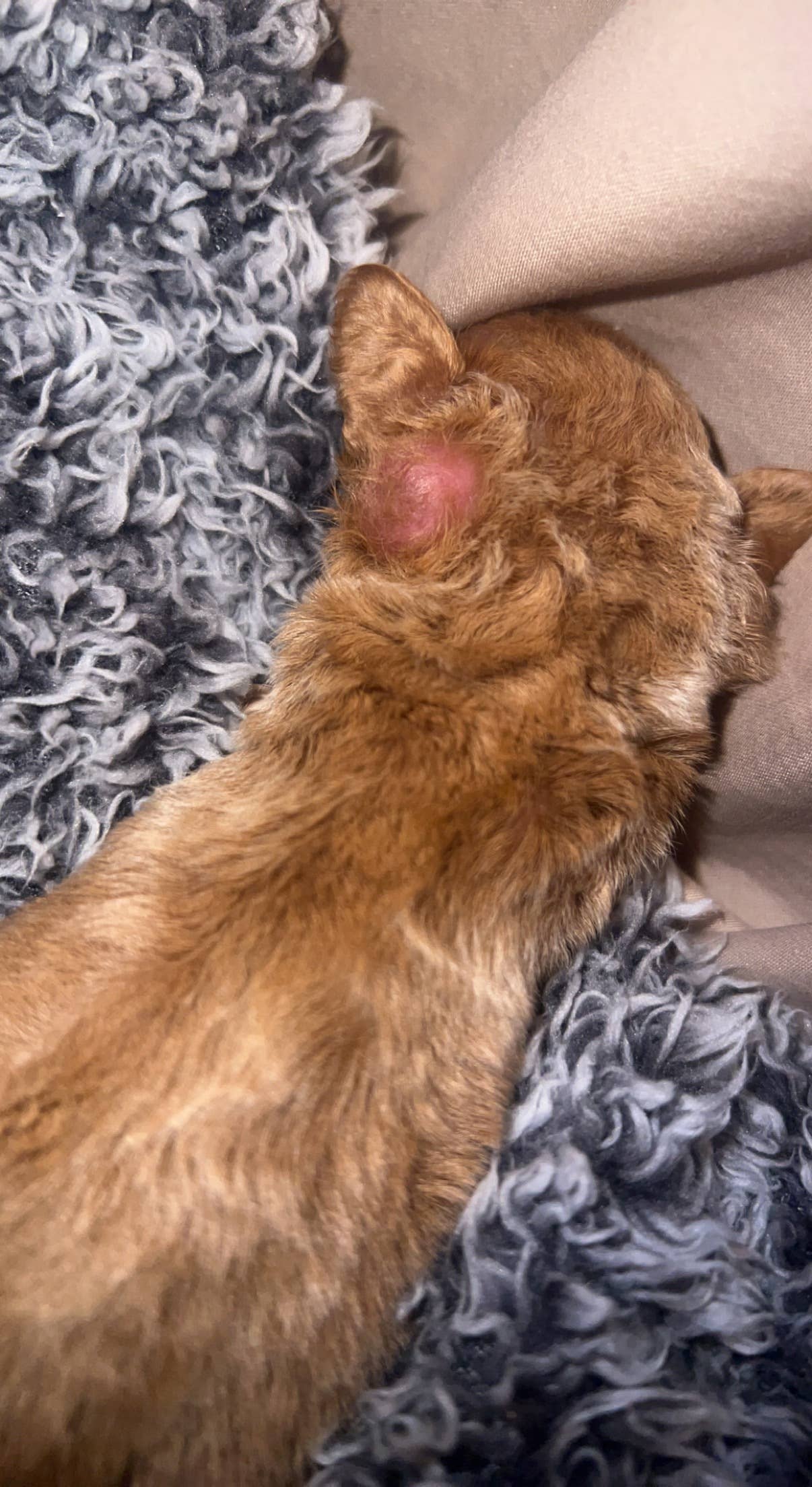
What Are These Lumps Behind My Dog’s Ears?
“My puppy was born 10 days early by emergency c-section (he was a conjoined twin). I’ve finally got him gaining weight after losing 10 of 11 pups in the litter. He has now developed lumps behind his ears, and his vet has not been helpful in the whole situation due to being inexperienced with this situation.” —Terra
Common Reasons for Ear Lumps in Puppies
Juvenile Cellulitis (Puppy Strangles)
The lump does not appear to be juvenile cellulitis, but this is one cause of puppies having swelling under the skin just below the ears. (1)
Puppy strangles can be difficult to treat, but if it is just an infection, the puppy will probably respond just fine to antibiotics. Your local veterinarian can prescribe antibiotics to help the puppy fight off the infection if that is what they find.
Lymphadenitis (Swollen Lymph Node)
It is also possible that it is just a simple case of lymphadenitis, a swollen lymph node. There are several causes of lymphadenitis in puppies, but in some cases, it may be due to an infection that needs to be treated.
Swollen lymph nodes like those seen on this puppy may be from a bacterial, viral, or fungal infection.
Take Your Puppy to the Vet ASAP
It is not possible to say what the lump is without an exam. I realize that you are reluctant to take him in, but your local veterinarian needs to clean the outside of the lump and then pull some of the contents out (aspirate) to see what is inside. Your dog may also need a blood count to monitor the severity of the infection.
Please get this looked at right away. Puppies do not have a lot of reserves and cannot go without medication for very long.
Source
(1) Bajwa J. Juvenile cellulitis (juvenile sterile granulomatous dermatitis and lymphadenitis) in a 9-week-old puppy treated with prednisolone-cyclosporine combination therapy. Can Vet J. 2022 Mar;63(3):313-316. https://www.ncbi.nlm.nih.gov/pmc/articles/PMC8842239/
This article is not meant to substitute for diagnosis, prognosis, treatment, prescription, or formal and individualized advice from your veterinarian. Animals exhibiting signs and symptoms of distress should be seen by a veterinarian immediately.
© 2023 Mark dos Anjos, DVM