

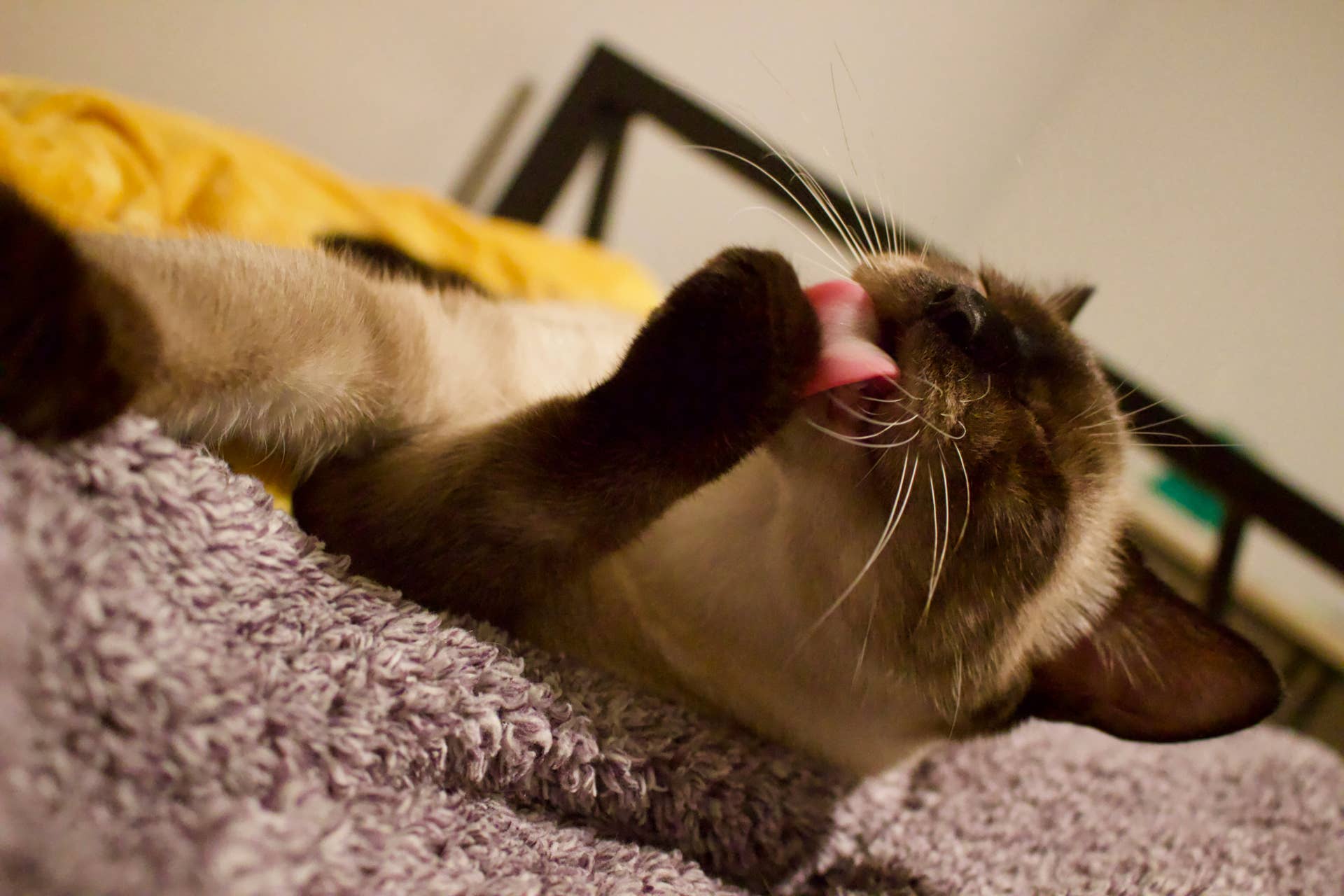
Cats are the ultimate “clean freaks” of the animal kingdom. They come equipped with a sandpaper-like tongue meant to ensure that every inch of their luxurious fur remains spotless.
The drive to groom themselves is so strong that, in a 2000 study, if a cat was prohibited from grooming for 72 hours, a 67% increase in oral grooming would take place in the following 12 hours. Now that’s a lot of grooming!
But all that grooming isn’t just about Sylvester trying to look fabulous—cats have their own very good reasons for all the licking. However, when those licking instincts kick into overdrive, that can be a sign that something’s off.
It’s up to you as a cat parent to investigate what might be causing your cat’s over-grooming habit to suddenly go topsy-turvy. While some forms of excessive grooming may be due to a minor issue that can easily be addressed, others may be more serious.
Related: The #1 Reason Cat Parents Should Be Concerned if Their Kitty Poops Outside the Litter Box
Normal Cat Grooming
Before exploring the topic of excessive grooming in cats, it helps to first identify what normal grooming looks like: Oral grooming is the most common way cats groom themselves—cats use their mouths to lick and nibble on their fur. Another way cats groom themselves is by scratching.
Grooming is so much part of being a cat that a decrease in grooming can signal depression or a sick cat. Yet, excessive grooming can also signal a problem—so how much grooming is normal, and how much is too much?
When researchers evaluated cats, they found that they would spend approximately 15% of a 24-hour day in some type of grooming, but of course, this may vary based on several factors, such as early experiences, genetic factors, and the type of coat, points out veterinary behaviorist Dr. Bonnie V. Beaver in her book Feline Behavior.
What’s the Function of Grooming in Cats?
Grooming has various functions that will totally change the way you perceive your cat’s fastidious habit. Ready to explore?
- Keeps the cat’s fur clean: With their rough tongues, cats effectively remove dirt, debris, and loose hair (hello, hairballs!).
- Keeps the skin healthy: By grooming, cats maintain their skin health and keep free of dander and mats. Mats and tangles can pull on the cat’s skin, leading to discomfort, irritation, and even potential skin infections or the perfect habitat for parasites to thrive.
- Gets rid of pesky parasites: In a 2000 study, cats who were allowed to lick were found to have fewer fleas than cats who were forced to wear an Elizabethan collar (the so-called “cone of shame”) and were prevented from licking.
- Lowers body temperature: While humans cool off by sweating or turning on the A/C, cats can cool down by licking. In a 2018 study, cats were found to rely on saliva evaporation for cooling, with licking accounting for up to one third of their total evaporative cooling.
- Helps relieve tension: Over-grooming may sometimes occur when cats are overwhelmed with strong emotions, as may happen when they are stressed, conflicted, frustrated, or in a heightened state of arousal. It’s therefore not unusual to see a bout of licking when cats are reprimanded by their owners or after an encounter with an aggressive cat.
Related: My Cat Throws Up After Eating … Could It Be Anxiety?
When Does Grooming Become Excessive?
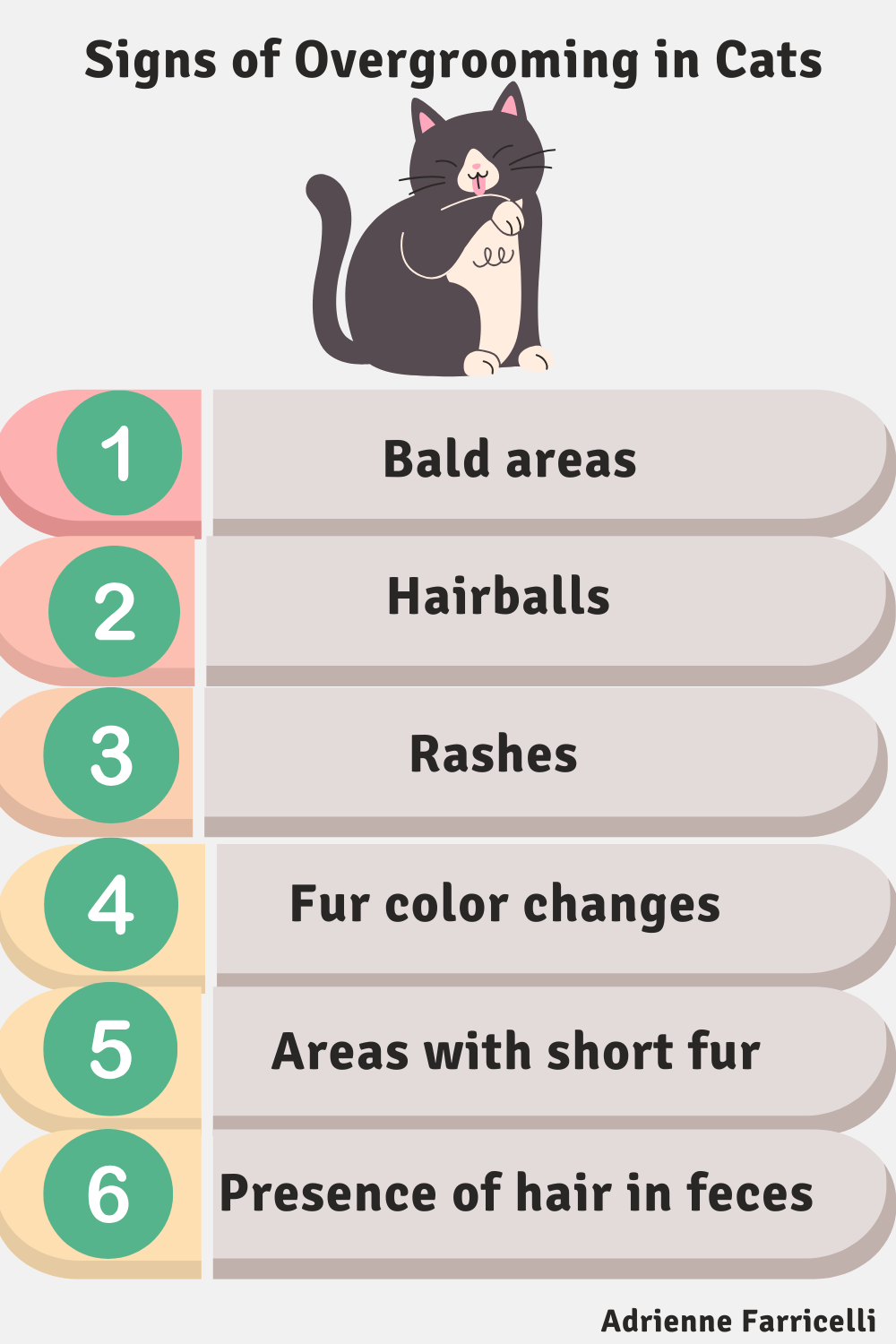
Signs of your cat’s grooming getting out of hand include:
- Bald spots
- Frequent vomiting of hairballs
- Presence of hair in the feces
- Skin rashes
- Areas with shorter fur
- Changes in fur color
Medical Causes
Any cat that shows signs of over-grooming should be taken to the vet. Over-grooming is often a sign of some underlying medical issue.
Skin Problems
Excessive licking can be a sign of a cat feeling itchy (pruritus). Affected cats may be seen licking, scratching, chewing, or biting their skin, leading to hair loss, redness, and inflammation.
A variety of skin conditions can affect cats and cause excessive grooming. These may include allergies (food, dust mites), parasitic skin conditions (due to fleas, mites, fungi), and bacterial or yeast skin infections, just to name a few.
Internal Problems
Sometimes, cats groom excessively when they are suffering from some type of internal problem. For instance, if they have pain, they may target their licking to a specific body part, but it’s not always easy to pinpoint the source of the pain.
Excessive licking can be tied to various health problems, including gastrointestinal disease, disc disease, bladder inflammation, arthritis, and problems with the anal sacs.
How to Fix Medical Over-grooming
The best approach is to visit your vet and provide as many details about the licking episodes as possible. Provide detailed information about when it all started, what food you’ve been feeding your cat, products you’ve been using to fight common parasites, and other pertinent information.
Challenging cases may prompt a referral to a board-certified veterinary dermatologist. Yes, cats can have their own dermatologists too!
“While most pet parents feel that their pet’s licking has to be behavioral, most of the time it isn’t. Before we call licking behavioral, we want a good dermatologic workup and GI workup.” —Lisa Radosta, board-certified veterinary behaviorist
Behavioral Causes
It’s important to note that behavioral causes of over-grooming in cats are normally a diagnosis of exclusion. In other words, medical causes need to be first ruled out. Following are several behavioral causes of over-grooming in cats.
An Attention-Seeking Behavior
Cats who crave attention may start grooming excessively if they notice that it garners attention from their owners. Any form of attention, such as attempting to interrupt the behavior, trying to comfort the cat, or checking for any lesions, may end up reinforcing the behavior.
A tell-tale sign of an attention-seeking disorder is the problem behavior occurring in the presence of select individuals.
While this form of attention-seeking grooming may start innocently, it can get out of hand and potentially become a bigger problem if not addressed early.
Feelings of Boredom
As curious and intelligent beings, cats thrive when they’re provided with an environment that meets their basic needs for hunting and exploration. A lack of a stimulating environment can cause feelings of frustration and boredom.
Stress
Cats also thrive when they’re provided with a certain level of consistency and predictability in their lives. Changes in their environment, such as a move, alterations in their caretaker’s work schedule, or a new baby, spouse, or pet, can readily cause them stress.
In these cases, grooming helps make up for the lack of mental or physical stimulation and can also act as a form of stress relief. When the excessive grooming leads to hair loss, it’s referred to as “psychogenic alopecia.”
This can be particularly common in sensitive or high-strung cat breeds, such as Siamese, Abyssinian, Burmese, and Himalayan cats.
A Displacement Behavior
Sometimes, cats may feel conflicted about engaging in two different behaviors. For example, if a cat is conflicted about whether to approach a person or retreat, he may decide to engage in a third behavior, such as grooming himself instead.
This out-of-context grooming behavior helps distract the animal, lower its arousal levels, and deflect any social conflict or agonistic interactions, explains board-certified veterinary behaviorist Dr. Vint Virga.
While displacement grooming tends to occur in response to some type of transient stressor, the presence of recurrent or sustained stress may lead to cases of over-grooming.
A Compulsive Disorder
Behaviors are described as being compulsive when they are repetitive and driven by an attempt to prevent or reduce feelings of anxiety or distress.
While in humans, the term obsessive-compulsive disorder (OCD) is used, when it comes to pets, the term “obsessive” is dropped because we can’t really confirm whether they truly experience an obsession (an intrusive thought).
In cats, over-grooming may be a sign of a compulsive disorder, although its occurrence is relatively rare. The cat engages in it excessively, repeatedly, and persistently, even if an identifiable source of stress or conflict is removed. The excessive grooming may lead to hair loss (psychogenic alopecia).
It goes without saying that compulsive disorders can put a dent in the cat’s life, as they can be difficult to interrupt and interfere with normal functions.
Related: Why Is My Cat Chasing and Biting His Tail?
How to Fix Behavioral Over-grooming
Because several of the underlying causes of behavioral over-grooming stem from underlying stress, most solutions involve strategies aimed at alleviating the stress.
Identify Stressors
Cats are sensitive animals who can readily become stressed by even small changes in their environments. Identifying the underlying causes of stress isn’t always easy. Observe your cat’s body language for signs of fear or stress and track down any recent changes in his routines that could have acted as a disruption.
Remove Stressors
If you can identify stressors, remove them if possible. If this is not feasible, try to present them in a less stress-inducing form. For example, if your cat is scared of people visiting, make sure she has access to a place to retreat to that gives her enough distance to feel safe.
Stick to Routines
Cats, like dogs, are routine-oriented animals. Knowing what to expect during their day helps them feel reassured. If you need to add changes to your cat’s environment, make sure to do so gradually so that these changes are easier to assimilate.
For example, if you need to relocate the litter box, start by moving it a few inches every day until it reaches its new location. This can help lower the chances of your cat becoming confused or stressed.
Create Safe Zones
Your cat should have access to an area where she can retreat if she feels threatened by something or simply wants to take a break from other boisterous pets or children.
Avoid Giving Attention
In cases of attention-driven cats, it’s important to avoid rewarding the behavior with attention. Consider that to a cat craving attention, any form of attention will satisfy them—and that also includes attention of the negative type, such as reprimanding the cat.
Related: 12 Ways to Keep a Stubborn Cat Off Kitchen Countertops
Avoid Behavior Chains
If you use redirection to interrupt your cat and reward him, you need to be careful to avoid a behavior chain (accidental reinforcement).
For example, if you call your cat’s name and give him a treat the moment he starts grooming, you don’t want your cat to accidentally associate the unwanted behavior with the reward and think, “When I do X behavior, I get something good.”
To break the chain, you can ask your cat to perform a behavior before you deliver the treat, such as asking him to sit and then rewarding him with a treat or toy, suggests veterinary behaviorist Dr. Leslie Sinn in the book Decoding Your Cat.
Use Calming Aids
Nowadays, there are a variety of calming aids for cats, from pheromone diffusers (Feliway) to calming foods and supplements. Ask your vet for specific recommendations.
Provide Enrichment
Cats are curious animals who love to explore and practice their hunting skills. Enrich your cat’s life by organizing fun treasure hunts (hide your cat’s kibble around the house), providing interactive toys and food puzzles, and having fun play sessions with your cat.
Don’t forget about training! Cats can be trained too. In fact, when I was training my Rottweilers, my two cats couldn’t resist joining in. They made a beeline, eager to learn and participate (and enjoy the tasty treats).
Avoid Punishment
Hearing nonstop licking can sometimes feel frustrating, but it’s important that all forms of punishment be avoided. Punishments such as reprimanding the cat, using a spray bottle, or making loud noises risk causing the cat more stress, which may trigger—you guessed it— more grooming.
Work With a Specialist
Cases of feline over-grooming can be challenging to diagnose and treat. Left untreated, they tend to worsen rather than get better. Medical causes need to be addressed, and behavioral ones require careful management and treatment.
Compulsive disorders require a multimodal approach, including treating any concurrent medical conditions, removing sources of stress, over-arousal, or conflict, and offering a consistent routine of exercise, play, and mental stimulation.
Behavior modification often consists of desensitization and counterconditioning, distraction techniques, and training alternate behaviors that compete with the repetitive behavior. The vet may prescribe medications as well.
A board-certified veterinary behaviorist can help ensure the correct implementation of behavior modifications and prescribe prescription medications as needed.
The Challenges of Over-grooming
When it comes to over-grooming, the biggest challenge is differentiating forms stemming from an underlying medical problem and forms stemming from a behavior problem. The latter are generally less common, but they are often linked to stress, anxiety, or insufficient mental stimulation.
To compound things further, consider that there may be cases of chicken-or-egg dilemmas. Is the cat over-grooming because of a behavior issue, with the constant licking triggering skin problems? Or is the over-grooming driven by an underlying medical condition, which has become an addictive habit even after the medical issue is resolved?
Either way, the cycle can spiral, leaving the cat stuck in an endless loop of licking.
Up Next:
References
- Eckstein, Robert & Hart, Benjamin. (2000). Grooming and control of fleas in cats. Applied animal behaviour science.
- Eckstein, R.A., Hart, B.L., 2000. The organization and control of grooming in cats. Appl. Anim. Behav. Sci.
- Hart B. Feline Practice. Veterinary Practice Publishing Co.; Santa Barbara, CA: 1976. Feline behavior: The role of grooming activity; pp. 14–16
- A.C. Noel, D.L. Hu. (2018). Cats use hollow papillae to wick saliva into fur. Proc. Natl. Acad. Sci. U.S.A.
- Beaver BV. Feline Behavior. Elsevier Health Sciences; St. Louis: 2003
- DVM360: Self-directed behaviors in dogs and cats
- Decoding Your Cat: The Ultimate Experts Explain Common Cat Behaviors and Reveal How to Prevent or Change Unwanted Ones by American College of Veterinary Behaviorists
Disclaimer: Dog training and behavior modification, particularly for challenges involving potential aggression (e.g., lunging, barking, growling, snapping, or biting), require in-person guidance from a qualified behavior professional. Online articles are for educational purposes only and do not replace personalized, professional intervention.
By using this information, you accept full responsibility for your dog’s actions and waive any liability claims related to their behavior. If your dog shows concerning behaviors, seek professional help immediately to ensure safety and proper care.